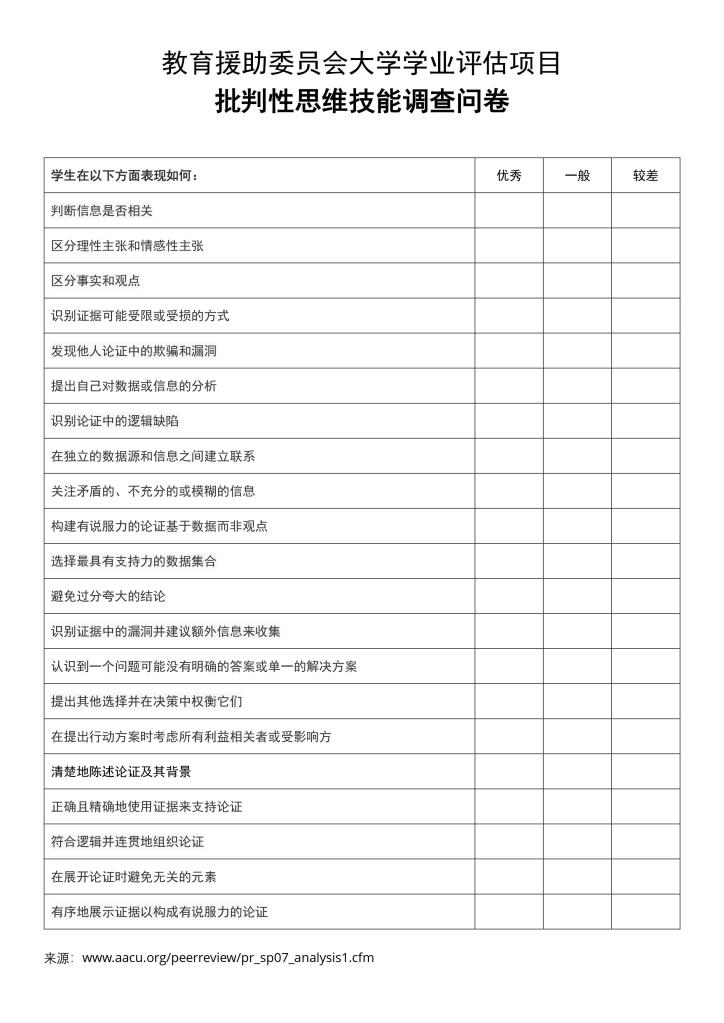
重要的内容都在上面这张调查问卷中了,教育援助委员会(Council for Aid to Education)和大学学业评估项目(Collegiate Learning Assessment Project)先放在一边。不知道有多少人注意到这个清单最下面的链接 www.aacu.org/peerreview/pr_sp07_analysis1.cfm 其实已经打不开了。这个链接从《批判性思维(第 9 版)》开始引入,现在点击只会跳转到 AACU 官网的 404 网页。
这个 AACU 是 Association of American Colleges & Universities 的缩写,美国大学与学院协会是一个成立于1915年的全球性会员组织。而这个 Peer Review 是他们的一本关于本科教育的季刊。那我们观察一下这个链接就会发现它指向的是 2007 年的春季刊(Spring)。而打开这本季刊就会发现 analysis1 指向的是 ANALYSIS 专栏下的第一篇文章 Richard H. Hersh 的 “Going Naked”。至于这个 cfm 则是一种文档的后缀,可以理解成类似 html,很多时候用来展示或实现和 pdf 文档的交互。扯远了。
Richard 是大学学业评估(CLA)项目的联合主任,浏览教育援助委员会的官网 https://cae.org 可以了解这个项目的最新进展。
在了解以上信息的过程中发现,美国的本科教育还是很注重学生的批判性思维的培养的。批判性思维的技能列表中英对照翻译也放在下面,以供和中文版出版物对照参考。
| 原文 | 翻译 |
|---|---|
| How well does the student | 学生在以下方面表现如何: |
| determine what information is or is not pertinent; | 判断信息是否相关 |
| distinguish between rational claims and emotional ones; | 区分理性主张和情感性主张 |
| separate fact from opinion; | 区分事实和观点 |
| recognize the ways in which evidence might be limited or compromised; | 识别证据可能受限或受损的方式 |
| spot deception and holes in the arguments of others; | 发现他人论证中的欺骗和漏洞 |
| present his/her own analysis of the data or information; | 提出自己对数据或信息的分析 |
| recognize logical flaws in arguments; | 识别论证中的逻辑缺陷 |
| draw connections between discrete sources of data and information; | 在独立的数据源和信息之间建立联系 |
| attend to contradictory, inadequate, or ambiguous information; | 关注矛盾的、不充分的或模糊的信息 |
| construct cogent arguments rooted in data rather than opinion; | 构建有说服力的论证基于数据而非观点 |
| select the strongest set of supporting data; | 选择最具有支持力的数据集合 |
| avoid overstated conclusions; | 避免过分夸大的结论 |
| identify holes in the evidence and suggest additional information to collect; | 识别证据中的漏洞并建议额外信息来收集 |
| recognize that a problem may have no clear answer or single solution; | 认识到一个问题可能没有明确的答案或单一的解决方案 |
| propose other options and weigh them in the decision; | 提出其他选择并在决策中权衡它们 |
| consider all stakeholders or affected parties in suggesting a course of action; | 在提出行动方案时考虑所有利益相关者或受影响方 |
| articulate the argument and the context for that argument; | 清楚地陈述论证及其背景 |
| correctly and precisely use evidence to defend the argument; | 正确且精确地使用证据来支持论证 |
| logically and cohesively organize the argument; | 符合逻辑并连贯地组织论证 |
| avoid extraneous elements in an argument’s development; | 在展开论证时避免无关的元素 |
| present evidence in an order that contributes to a persuasive argument? | 有序地展示证据以构成有说服力的论证 |

 批判性思维
批判性思维 
留下评论